On Location: Cape Verde Islands
April 30, 2012Written by Rich Pagen
From the quaint and colorful port city of Mindelo, we drove up a steep and winding cobblestone road to Mount Verde, the highest peak on the Cape Verde island of São Vicente. The Cape Verde Islands are the final landfall as one heads west from Senegal, and as we looked out across the deep blue ocean, we could imagine that once past the neighboring island of Santo Antão, only open ocean lay between us and the Caribbean’s Lesser Antilles, far to the west.
Once at the top of the mountain, we stood at nearly 2,400 feet, bracing ourselves against a strong cool wind. This is the same southwesterly wind that directs the cold Canary Current, and the same one that pushed early sailing ships, including those in Christopher Columbus’ first voyage of exploration, towards the New World. Clouds whipped past us and, as they periodically parted, we could look all the way down across the dry lowlands to the city of Mindelo, over to the Clipper Odyssey alongside the pier.
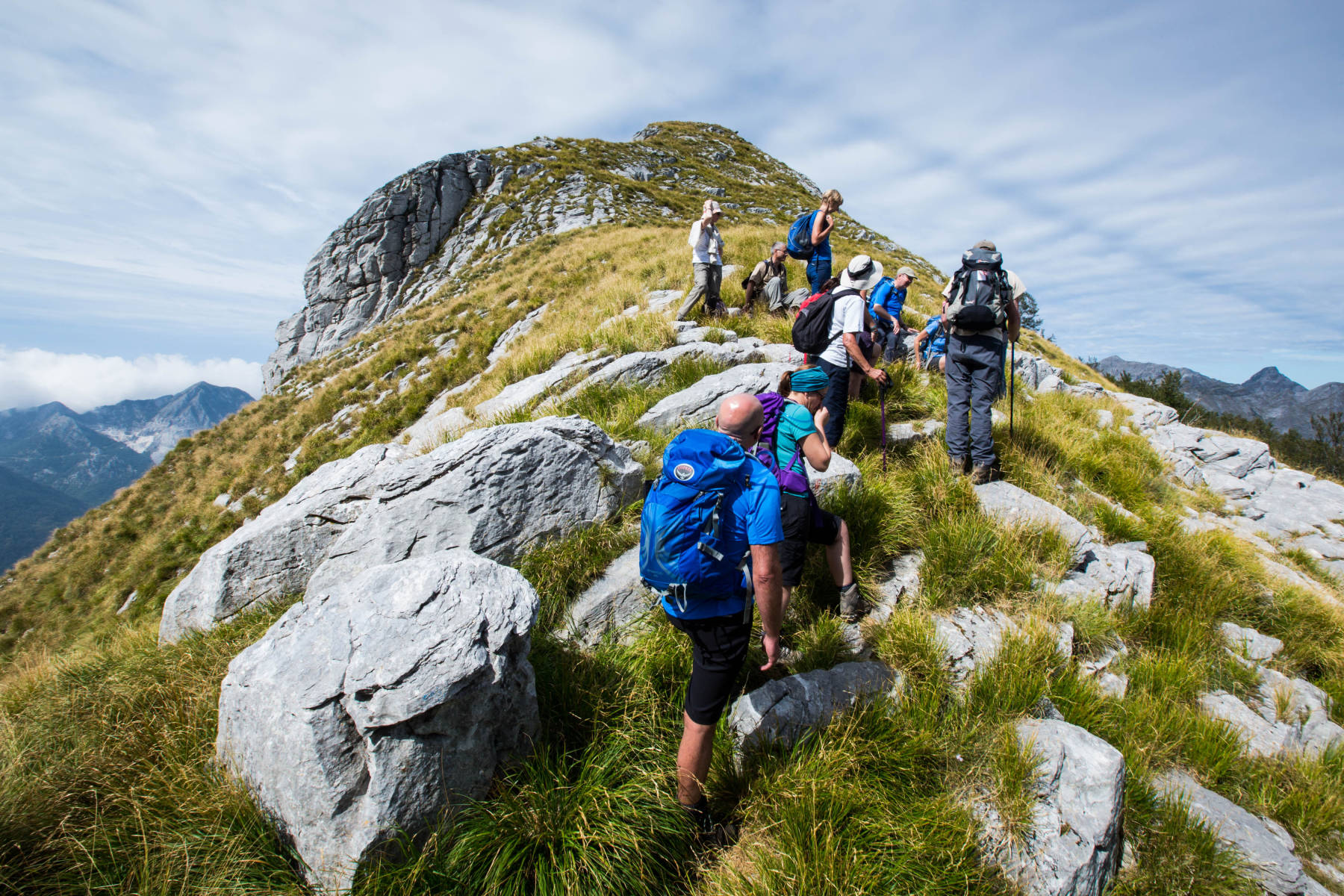
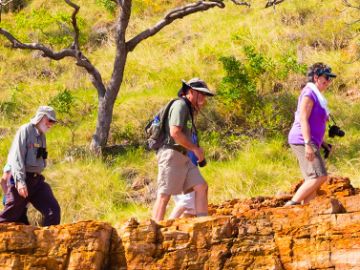
Many of us opted to walk partway down the mountain, admiring the spectacular volcanic rock formations on the way. Small terraces, created and cleared of rock by the local people, housed the remnants of corn and tomato plants, while the stone walls surrounding the terraces were popular perches for the endemic falcon curiously named, the neglected kestrel.
Next up - Spain's Canary Islands.
On Location: Blue Corner, Palau
April 27, 2012Written by Jack Grove
The weather has been exceptional since we have embarked on the Palau Aggressor II. Each day has been an adventure both above and below the surface of these amazingly diverse tropical seas. The corals appear to have recovered from recent El Nino events, and the protection afforded by the Palau Shark Sanctuary is evident in the increased numbers of sharks.
Our dive yesterday at the fabled Blue Corner was one of the best I have ever experienced. Crystal clear waters with numerous gray reef sharks passing by as we were entertained by curious, almost comical Napoleon wrasses, each weighing close to a hundred pounds. At Big Drop, we snorkeled above a vertical wall of colorful soft corals and shoals of butterflyfish and fairy basslet; we watched in amazement, the spawning of bird and checkerboard wrasses as they preformed a courtship dance and launched their gametes into the tropical seas. WOW!
All for now ... Landing at Pelelieu soon. FAIR WINDS.
On Location: Principe Island
April 26, 2012Written by Kevin Clement
There is something about islands. Islands are special places. The more remote and isolated they are, the more this is true. As proof, consider the exotic island of Principe, off the West Coast of Africa. It is special in several disparate and important categories.
Geopolitically: Along with a neighboring speck of land called Sao Tome, Principe is a country. One of the smallest and most oddly configured nations on earth, sensibly enough named the Republic of Sao Tome and Principe. It has its own independent government, makes its own laws, levies its own taxes, etc. It’s certainly one of the more difficult countries on earth to get to.
Geologically: Both islands are volcanic peaks that poke up out of the sea, an extension of a chain that runs across the West African mainland. Their topography is complex, with numerous overlapping craters, collapsed craters, crater walls, and volcanic plugs of varying ages.
Geographically: What this rugged and dramatic landscape has meant, however, is that the natural heritage of the islands, which it once shared with the Congolese rain forest on the mainland coast, has been preserved. The islands are simply too forbidding to farm, too distant to attract colonists, and too rough to support a dense population. So its lush forests are in a better state of preservation than perhaps anywhere on the former belt of rain forest in continental West Africa.
Biologically: Islands are hotbeds of evolution. Their isolation means that species that happen to arrive there, separated forever from their continental antecedents, tend to diverge and go their own evolutionary way. So it is that Principe harbors a number of endemic species (ones that live nowhere else on earth), most notably birds like the velvet-mantled drongo, and the Principe glossy starling, speirops, sunbird, golden weaver, and kingfisher.
All of these factors make Principe an ideal place for us to visit on this itinerary, and a place I enjoyed immensely. We based out of the surprising and gorgeous Bom-Bom Resort, situated partially on a small outlying island by that name. We hiked in the forest—glorious, rich rain forest. Many trees were in flower, notably some huge orange-flowered Erythrinas. We came across towering emergent trees, whose trunks pierced the canopy and whose branches reached into the sky, including a kapok or ceiba tree, one of the few species that lives in both Africa and the New World tropics. And we saw all the birds mentioned above.
Some of us also visited an inland village—quirky and almost forgotten, as island towns tend to be—and snorkeled from the beach on the volcanic rocks near the resort.
There is a great deal special about Principe…and all of it derives from one characteristic it possesses: isolation. To be special, a place must be different from the run of the mill, and being different requires separation, distance, and lack of contact. We at Zegrahm Expeditions seek out the Principes of the world, the difficult, remote, special places. And it just so happens many of them are on islands.
On Location: Rock Islands, Palau
April 23, 2012Written and photographs by Jack Grove
Greetings from Palau!
The Palau Aggressor II sailed away from the Koror dock in the pre-dawn hours and we arrived at the Rock Islands in the early morning. The weather is perfect and the expedition is off to a marvelous start. Our first snorkeling and diving programs went perfectly. Please enjoy these incredible pictures of the Rock Islands' Coral Gardens.
Fair Winds,
Jack


On Location: Contonou, Benin
April 16, 2012Written by Rich Pagen
We awoke to the bustling port city of Cotonou, with the sun rising over numerous tanker ships awaiting their opportunity to offload. We drove through morning traffic, dominated by large trucks and motorcycles, including the abundant motorcycle-taxis called Zémidjans. Vegetable stands lined the side of the road, as did vendors selling jugs of smuggled gasoline from Nigeria, a practice accepted by Benin’s government as they cannot supply nearly enough to meet the demands of the country.
We stopped at a Sacred Forest outside the city of Ouidah, where towering trees hosted roosting straw-colored fruit bats, whose screeches carried far across this impressive place. We were led through a series of Vodun (Voodoo) statues representing several of the religion’s spirits, as well as a museum housed in the Fort of São João Baptista de Ajudá, the former center of the Portuguese and African slave trade in this area. We also stopped along an exposed sandy beach at the Door of No Return, the site from which slaves had been shipped across the Atlantic.
After lunch on a beautiful hotel patio along the coast, we drove out to the shore of marshy Lake Nokoué and boarded small covered boats for the ride out to the lake village of Ganvie. The name of this community of 30,000 people, situated far from the shore, translates to “free at last," and refers to the fact that this place was a safe haven from slave traders.
Dugout canoes with sails plied past us with the breeze, while long wooden poles were used to move the canoes back up against the wind. Fish traps and nets were everywhere, and the marsh vegetation seemed to go on forever in all directions. Stilted houses sat perched above the water, and we got out to watch a traditional Voodoo mask dance. As the dancers in bright costumes spun and gyrated to the drumbeats, we had no doubt that we were at the epicenter of West Africa’s Voodoo religion.